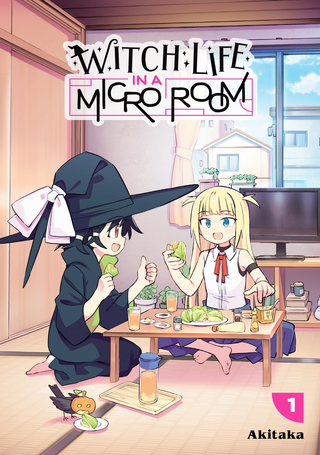
Title: Living Large in Three Tatami Mats: A Deep Dive into "Witch Life in a Micro Room"
In the vast landscape of modern manga, where "isekai" power fantasies and high-stakes battle shonen often dominate the charts, there is a delightful subgenre that thrives on the "extraordinary within the ordinary." One of the most charming and visually striking examples of this in recent years is "Witch Life in a Micro Room" (originally titled *Gokusema Micro Room de Majo to Kurashitemita*), written and illustrated by the talented Maru Mikan. As an otaku who has spent decades analyzing the nuances of sequential art, I find this series to be a masterclass in spatial storytelling and character-driven comedy.
The Plot: A Cramped Supernatural Coexistence
The story follows Kouta, a typical, albeit severely impoverished, university student. In an effort to save every possible yen, Kouta lives in a "micro-apartment"—a room consisting of only three tatami mats (roughly 50 square feet). His life is a monotonous cycle of studying and surviving on a shoestring budget until the literal fabric of his reality is torn open.
Suddenly, a beautiful, high-ranking witch named Lilith teleports into his tiny living space. Lilith isn't your average "magical girl" archetype; she is a powerful, elegant, and somewhat haughty figure from a magical realm who finds herself stranded in the human world. The catch? Due to the nature of her arrival and the constraints of Kouta’s living situation, she has nowhere else to go.
The narrative engine of the manga is the forced proximity of these two polar opposites. Kouta is a pragmatic, grounded human trying to maintain a semblance of a normal life, while Lilith is a creature of whim and immense power who knows nothing of human common sense or the struggles of poverty. The "micro room" becomes a pressure cooker for comedy, fanservice, and surprisingly tender moments of domesticity.
Demographic and Genre: The Seinen Edge
"Witch Life in a Micro Room" is categorized as a Seinen manga, having been serialized in Kodansha’s *Weekly Young Magazine*. This demographic classification is crucial to understanding its tone. While it features elements of romantic comedy and "ecchi" (suggestive) humor, it possesses a level of maturity and groundedness that distinguishes it from Shonen titles.
The Seinen tag allows Maru Mikan to explore the physical intimacy and the awkwardness of two adults sharing a space where they are constantly within arm's reach. The humor is often sophisticated, playing on the tropes of the "magical girlfriend" genre while subverting them with the harsh realities of Japanese urban living. It targets an older male audience that can relate to the struggles of early adulthood, student life, and the fantasy of a supernatural escape.
Key Themes: Space, Poverty, and Perspective
1. The Paradox of Space:
The central theme is the exploration of physical vs. emotional space. In a room where you can touch both walls simultaneously, privacy is non-existent. The manga brilliantly uses this constraint to accelerate the relationship between Kouta and Lilith. Every movement is a choreographed dance, and every interaction is amplified by their proximity.
2. Magic vs. Mundanity:
There is a recurring thematic contrast between Lilith’s grand magical background and Kouta’s "micro" lifestyle. Seeing a powerful witch try to understand the value of a discount bento box or the mechanics of a coin laundry provides a satirical look at our own world through the eyes of the "other."
3. The Comfort of the Small:
Despite the initial claustrophobia, the manga carries a theme of finding contentment in small things. It romanticizes the "tiny house" lifestyle, suggesting that happiness isn't found in vast mansions, but in the quality of the company you keep within your own four walls—no matter how close those walls may be.
Why You Should Read It
Visually, Maru Mikan’s art is top-tier. The character designs are expressive, and the attention to detail in the cluttered, tiny apartment makes the setting feel like a character in itself. For fans of series like *Ah! My Goddess* or *Uzaki-chan Wants to Hang Out!*, this manga offers a more condensed, Seinen-oriented twist on the "supernatural roommate" trope.
"Witch Life in a Micro Room" is more than just a comedy about a cramped apartment; it is a heartwarming and frequently hilarious look at how two people from different worlds can find a common language in the most unlikely of places. Whether you are here for the supernatural intrigue or the cozy slice-of-life vibes, this micro-room is definitely worth a visit.
📖 Leer online en Donmanga:
➡️ Witch Life in a Micro Room – Leer Manga