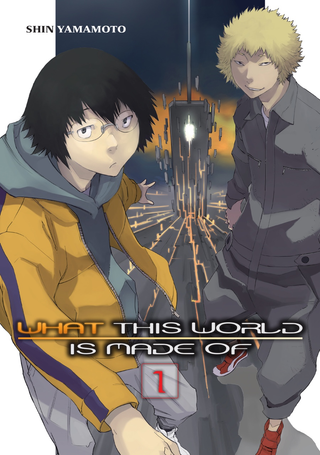
As an avid follower of the medium, it is always a thrill to see a mangaka pivot from a massive success to something entirely different in tone and scope. "What This World Is Made Of" (Japanese title: *Kono Sekai wa Nani de Dekite Iru no ka*) is the latest venture by Shin-ichi Fukuda, the celebrated creator of the rom-com sensation *My Dress-Up Darling*. However, if you are expecting cosplay and lighthearted romance, prepare for a jarring—yet masterfully executed—tonal shift. This series is a dive into the supernatural, the grotesque, and the existential.
The Premise: A World Behind the Veil
The story follows Kaname, a high school student who lives a life of quiet desperation. Since childhood, Kaname has been plagued by a terrifying visual anomaly: he sees "monsters." These aren't your typical fantasy creatures; they are distorted, glitch-like entities that inhabit the periphery of human society, often mimicking or replacing human beings. To everyone else, the world is normal, but to Kaname, the world is a decaying facade filled with predatory shadows.
Kaname’s life changes when he encounters a mysterious girl who not only sees what he sees but actively hunts these entities. This encounter pulls him into a hidden war for survival. He learns that these creatures are known as "Ghouls" (or similar translations depending on the scanlation/localization), beings that feed on human existence and "wear" the reality of our world. The narrative quickly evolves from a psychological horror into a high-stakes supernatural action series, as Kaname must decide whether to remain a passive observer or take up arms in a world that feels increasingly alien.
Demographic and Genre: A True Seinen Experience
"What This World Is Made Of" is categorized as Seinen, serialized in Square Enix’s *Young Gangan*. Unlike Shonen titles that often focus on the "power of friendship" or clear-cut heroism, this manga leans into the darker, more cynical sensibilities of the Seinen demographic.
The violence is visceral, and the psychological weight of the protagonist's isolation is palpable. Fukuda utilizes the Seinen framework to explore mature themes of alienation and the "uncanny valley," where the horror stems from things that look almost human but are fundamentally *wrong*. The art style, while retaining Fukuda’s signature character design polish, adopts a much grittier, more detailed approach to environmental storytelling and creature design.
Core Themes: Perception, Isolation, and Reality
The manga is built upon several profound thematic pillars:
1. The Subjectivity of Reality: The central conflict revolves around the idea that "reality" is merely a consensus. If only one person sees a monster, they are considered insane; if everyone sees it, it becomes a fact. Kaname’s struggle is a metaphor for neurodivergence or trauma—living in a world where your fundamental experience of reality is denied by those around you.
2. The Fragility of Normalcy: Fukuda masterfully depicts how quickly a mundane day can turn into a nightmare. The Ghouls represent the hidden rot beneath the surface of a polite, organized society. The manga asks: how much of our "normal" life is just a mask for something more predatory?
3. The Burden of Sight: Knowledge in this world is a curse. Once Kaname acknowledges the truth of what the world is "made of," he can never return to his blissful ignorance. This "point of no return" is a classic trope of the cosmic horror genre, updated for a modern urban setting.
Why You Should Read It
For fans of *Tokyo Ghoul
📖 Leer online en Donmanga:
➡️ What This World Is Made Of – Leer Manga