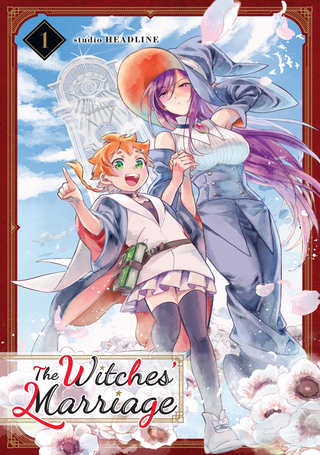
As a seasoned observer of the medium, it is always a pleasure to dissect a work that elegantly weaves together the threads of supernatural fantasy and intimate character study. "The Witches' Marriage" (known in Japan as *Majo no Kekkon*), written and illustrated by the talented Masumi Takeda, is a hidden gem that demands the attention of any connoisseur of the "Girls' Love" (Yuri) genre and high-concept fantasy.
Demographic and Genre Landscape
Serialized in Media Factory’s *Comic Flapper*, "The Witches' Marriage" falls firmly into the Seinen demographic. While many associate Yuri with the Shojo or Josei spheres, its placement in a Seinen magazine allows for a specific kind of narrative maturity—focusing less on high school melodrama and more on the existential weight of magic, the complexities of adult commitment, and a meticulously crafted world-level lore. It is a "Battle-Fantasy Romance" that prioritizes emotional resonance over mindless spectacle.
The Premise: Magic Fueled by Affection
The story centers on Melissa, a formidable and legendary witch known for her immense power but also her clinical, almost detached approach to the arcane arts. Melissa harbors a singular, ambitious goal: to open the "Door of Truth," a legendary gateway said to grant the seeker ultimate knowledge of the universe. However, the Door is not opened by sacrifice or ancient chants, but by a specific, volatile energy: the "Power of Love."
In a world where magic is intrinsically linked to the depth of one’s emotional bonds, Melissa realizes she cannot reach her goal alone. To generate the required magical output, she enters into a "Contractual Marriage" with her devoted apprentice, Tanya.
The Dynamic: A Dance of Intentions
The heart of the manga lies in the friction between its two leads. Melissa is the quintessential "dense" protagonist, albeit an intellectual one. She views the marriage primarily as a pragmatic tool—a battery to charge her magical reserves. To her, "love" is a variable to be optimized.
Tanya, on the other hand, provides the story's soul. Unlike Melissa, Tanya’s feelings are genuine, deep, and agonizingly real. She has been in love with her master for years, and while she agrees to the marriage to help Melissa achieve her dreams, she constantly grapples with the pain of being in a "fake" relationship with the person she loves most. This creates a fascinating power dynamic where Melissa holds the magical authority, but Tanya holds the emotional cards.
Plot Progression and World-Building
As the duo travels across a beautifully rendered fantasy landscape, they take on various "Witch Quests." These missions serve two purposes: they expand the world-building—introducing us to the ecological and political ramifications of magic—and they force the couple into situations that test their bond.
To increase their "Sync Rate" and produce stronger magic, they must perform acts of intimacy, ranging from holding hands to more vulnerable displays of affection. What begins as a calculated tactical maneuver for Melissa slowly begins to thaw her icy exterior. The reader witnesses a slow-burn transformation where the line between "acting for the sake of magic" and "feeling for the sake of each other" becomes irrevocably blurred.
Principal Themes
1. The Quantification of Emotion: The manga explores the philosophical question: Can love be measured? By making love a literal power source, Takeda asks if the *utility* of an emotion diminishes its *sincerity*.
2. Master and Apprentice Evolution: It subverts the traditional hierarchy, showing how Tanya’s emotional maturity eventually forces Melissa to grow as a human being, not just as a sorceress.
3. The Nature of Truth: While Melissa seeks the "Door of Truth" in the cosmos, the narrative suggests that the only truth worth finding is the one shared between two people.
Why You Should Read It
"The Witches' Marriage" is a visual and narrative treat. Masumi Takeda’s art style is clean yet expressive, capturing the ethereal beauty of spellcasting and the subtle blushes of a burgeoning romance with equal skill. It avoids the common pitfalls of "fanservice-heavy" Yuri, opting instead for a poignant, character-driven experience that rewards patient readers.
For fans of *The Magical Revolution of the Reincarnated Princess and the Genius Young Lady* or *I'm in Love with the Villainess*, this manga offers a slightly more grounded, Seinen-tinted perspective on magical romance. It is a story about the most powerful magic of all—not the kind that levels mountains, but the kind that opens a closed heart.
📖 Leer online en Donmanga:
➡️ The Witches' Marriage – Leer Manga