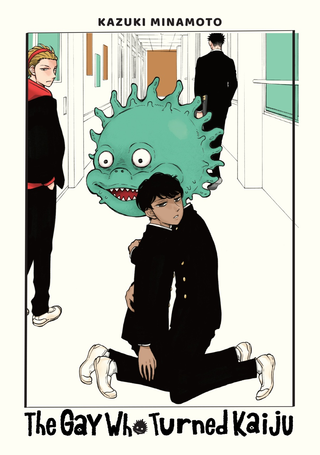
In the vast landscape of contemporary manga, few works manage to blend the surreal with the deeply personal as effectively as "The Gay Who Turned Kaiju" (Japanese title: *Kaijuu ni Natta Gay*). Written and illustrated by the visionary Kazuki Minamoto, this work stands as a poignant masterpiece that transcends the typical boundaries of the "monster" genre. As an erudite otaku who has seen countless transformations in fiction, I can confidently say that this manga uses the Kaiju trope not for spectacle, but as a visceral, heartbreaking metaphor for the LGBTQ+ experience in a rigid society.
Demographic and Context
First, let’s establish the framework. *The Gay Who Turned Kaiju* is categorized as a Seinen manga. Unlike Shonen, which often focuses on external battles and power progression, Seinen allows for a more mature, psychological, and often somber exploration of adult life. Originally serialized in *Comic Beam*—a magazine known for hosting avant-garde and alternative titles—this manga targets an audience looking for emotional depth and social commentary rather than simple escapism.
The Plot: A Metamorphosis of Pain
The story follows Takashi, a middle-aged man living a quiet, unassuming life in Japan. To his colleagues and neighbors, he is a "normal," albeit somewhat distant, salaryman. However, Takashi harbors a secret that he has kept buried for decades: he is gay. Having grown up in an era and environment where being different was equated with being "wrong" or "broken," Takashi has spent his entire existence wearing a mask of heteronormativity.
The narrative tension peaks when Takashi is forced to witness and endure the casual, everyday homophobia of those around him. He listens to the cruel jokes of his coworkers and the dismissive comments of a society that refuses to acknowledge his humanity. The psychological weight of this "closet" becomes a physical pressure. One day, the dam finally breaks. The repressed trauma, the self-loathing, and the silent screams of a lifetime manifest in a literal, physical transformation. Takashi becomes a Kaiju—a giant, terrifying monster.
Unlike *Godzilla* or *Ultraman*, where the monster is an external threat to be defeated, Takashi’s transformation is a manifestation of his alienation. He becomes the "monster" that society already perceived him to be, simply for being himself. As a Kaiju, he is finally visible, but at the cost of his humanity and his place in the world.
Main Themes: The Monster Within and Without
The brilliance of Minamoto’s work lies in its thematic layers:
1. Social Alienation and the "Other": The manga masterfully explores the concept of *othering*. In Japan, the "nail that sticks out gets hammered down." For Takashi, his sexuality made him the "nail." The Kaiju form is the ultimate expression of being an outsider; he is too big for the world he tried so hard to fit into.
2. The Weight of the Closet: The "closet" is often described as a dark place, but here it is depicted as a pressure cooker. The transformation serves as a metaphor for the "coming out" process when it is forced or triggered by trauma—it is explosive, destructive, and irreversible.
3. Internalized Homophobia: Much of the story deals with how Takashi views himself. He has spent so long hearing that his desires are "monstrous" that his body eventually agrees. The struggle isn't just against the military or the public, but against his own perception of his worth.
4. Humanity vs. Appearance: Even in his monstrous form, Takashi’s consciousness remains. The manga asks the reader: Who is the real monster? The man who looks like a beast but suffers with a human heart, or the "normal" people whose cruelty forced this transformation?
Why You Must Read It
*The Gay Who Turned Kaiju* is a challenging but essential read. The art style shifts beautifully between the mundane, cramped reality of urban Japan and the sprawling, chaotic scale of the Kaiju sequences. It is a story that demands empathy and offers a raw look at the scars left by systemic discrimination.
For fans of psychological Seinen like *Oyasumi Punpun* or the metaphorical storytelling of *GoGo Monster*, this is a must-add to your collection. It is a haunting reminder that the most terrifying monsters are often the ones we create through our own intolerance. Kazuki Minamoto has crafted a narrative that is as much a cry for help as it is a roar of defiance.
📖 Leer online en Donmanga:
➡️ The Gay Who Turned Kaiju – Leer Manga