# Exploring the Depths of the Mind: A Comprehensive Look at the OMORI Manga
For years, the indie gaming world was haunted and captivated by the surreal psychological horror of OMORI, developed by OMOCAT. Now, the narrative has transitioned into the realm of sequential art. Serialized in Kodansha’s prestigious *Monthly Afternoon* magazine starting in June 2024, and illustrated by the talented Waka Kono, the *OMORI* manga adaptation offers a fresh, visceral perspective on a story that has already become a modern cult classic. As an erudite observer of the medium, it is fascinating to see how this tale of trauma and escapism translates into the panel-by-panel language of manga.
Plot Overview: A Tale of Two Worlds
The story follows Sunny, a teenage boy who has spent the last four years as a *hikikomori* (shut-in), refusing to leave his house following a devastating tragedy. To cope with his isolation and the crushing weight of his reality, Sunny retreats into a dream world known as Headspace.
In Headspace, Sunny takes on the persona of Omori, a stoic, monochrome boy living in the infinite, cold "White Space." Accompanied by his childhood friends—the energetic Kel, the headstrong Aubrey, and the charming Hero—Omori embarks on whimsical adventures across a vibrant, candy-colored landscape. Their primary goal is to find their missing friend, Basil, who vanished after discovering something unsettling.
However, the manga masterfully balances this neon-soaked fantasy with the bleakness of the "Real World." As Sunny prepares to move away from his hometown, he is forced to confront the friends he abandoned and the truth he has buried deep within his subconscious. The narrative oscillates between the nostalgic, RPG-inspired quests of Headspace and the poignant, often painful interactions in Faraway Town, revealing that the monsters Omori fights in his dreams are mere shadows of the guilt Sunny carries in his heart.
Demographics and Categorization: The Seinen Edge
While the art style of Headspace might initially suggest a whimsical Shonen adventure, *OMORI* is firmly categorized as Seinen. Its serialization in *Monthly Afternoon*—the same home as masterpieces like *Vinland Saga* and *Blue Period*—underscores its mature approach to storytelling.
The Seinen classification is vital here. Unlike Shonen, which often focuses on external growth and battle power, *OMORI* focuses on internal deconstruction. It targets an older audience capable of navigating the nuances of mental illness, the permanence of grief, and the moral ambiguity of its protagonists. The manga does not shy away from the disturbing imagery of psychological horror, using the medium to amplify the "Something" that stalks Sunny—a manifestation of his trauma that is as terrifying on paper as it was on screen.
Core Themes: Trauma, Memory, and Escapism
The *OMORI* manga is a profound exploration of several heavy themes:
1. The Duality of Escapism: The manga examines how the human mind creates "safe spaces" to survive unbearable pain. Headspace is a beautiful lie, a frozen moment in time where everyone is still young and happy. The story questions at what point escapism stops being a shield and starts becoming a prison.
2. The Weight of Guilt: Central to the plot is the "incident" that fractured the group of friends. The manga meticulously portrays how guilt can distort one's perception of reality, manifesting as literal monsters or psychological barriers.
3. The Fragility of Friendship: Through flashbacks and real-world reunions, the story highlights how tragedy can either bond people together or tear them apart. The contrast between the idealized versions of Sunny’s friends in his dreams and their complicated, hurting adult selves is a recurring emotional anchor.
Visual Artistry and Adaptation
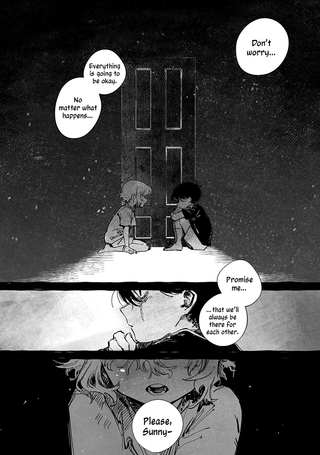
Waka Kono’s art is a revelation. The transition from the game’s hand-drawn, sketchy aesthetic to a detailed manga format allows for deeper character expressions. The "White Space" sequences utilize negative space to evoke a sense of profound loneliness, while the "Real World" segments use realistic shading to ground the story in its somber reality.
For fans of psychological thrillers like *Goodnight Punpun* or the surrealism of *Paprika*, the *OMORI* manga is an essential read. It is a hauntingly beautiful adaptation that respects its source material while utilizing the unique strengths of the manga medium to tell a story about facing the shadows of the past to find a glimmer of hope for the future.
📖 Leer online en Donmanga:
➡️ OMORI – Leer Manga