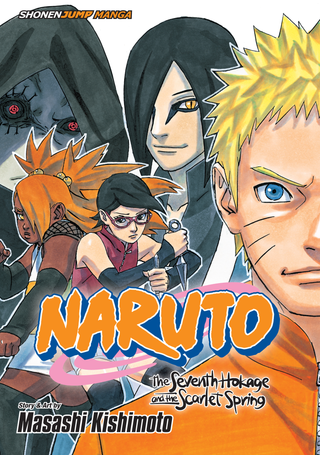
As a seasoned scholar of the shinobi arts and the vast bibliography of Masashi Kishimoto, it is my pleasure to delve into one of the most pivotal "bridge" narratives in the Shonen Jump canon. "Naruto: The Seventh Hokage and the Scarlet Spring" (known in Japan as *Naruto Gaiden: Nanadaime Hokage to Akitsuki no Hanayome*) is not merely a spin-off; it is a profound exploration of identity and the evolution of the "Will of Fire" in a post-war era.
Demographic and Context
Categorized strictly as Shonen, this manga targets a young male audience but resonates deeply with long-time fans who grew up with the original series. Published in 2015 as a limited mini-series, it serves as the essential connective tissue between the conclusion of the original *Naruto* manga (Chapter 700) and the beginning of *Boruto: Naruto Next Generations*. It marks a rare occasion where Kishimoto himself returned to the drawing board to illustrate and write a focused character study on the next generation of the Uchiha lineage.
Detailed Synopsis
The story unfolds several years after the Fourth Shinobi World War. The world is at peace, and Naruto Uzumaki has finally achieved his dream of becoming the Seventh Hokage. However, the focus shifts from the orange-clad hero to a new protagonist: Sarada Uchiha, the daughter of Sasuke and Sakura.
Sarada is a brilliant and perceptive student at the Academy, but she is haunted by a sense of incompleteness. Her father, Sasuke, has been away on a top-secret mission for years, and her memories of him are non-existent. Her domestic life with Sakura, while loving, feels shrouded in mystery. The tension reaches a breaking point when Sarada discovers an old photograph of Sasuke from his days in the "Hebi" organization. In the photo, Sasuke is standing next to a woman wearing glasses—Karin—who bears a striking resemblance to Sarada.
Driven by a desperate need to confirm her biological heritage and confront the man who has been absent for her entire life, Sarada decides to leave the Hidden Leaf Village. Accompanied by her eccentric friend Chōchō Akimichi, she secretly follows Naruto, who is heading to a rendezvous point to meet Sasuke.
However, the journey is fraught with danger. A mysterious boy with the Sharingan and a pale, scarred man known as Shin Uchiha emerge from the shadows. Shin is an anomaly—a man obsessed with the legacy of Itachi Uchiha and the concept of "evolution through conflict." He views the current peace as a stagnation of human potential and seeks to revive the Akatsuki. As Naruto and Sasuke reunite to protect the children, Sarada is forced to navigate a battlefield of high-stakes ninjutsu and even higher emotional stakes, questioning what it truly means to be a family when blood ties are put into doubt.
Main Themes
1. Biological vs. Emotional Legacy:
The core of the "Scarlet Spring" is the conflict between *nature* and *nurture*. Sarada’s quest is a literal search for her DNA, but the narrative ultimately argues that a family is defined by the "connection of feelings" rather than genetic markers. This subverts the traditional Shonen obsession with bloodlines (Kekkei Genkai) by prioritizing emotional bonds.
2. The Burden of the Uchiha:
The Uchiha clan has historically been defined by the "Curse of Hatred." Through Sarada, Kishimoto explores a new path for the clan. Her awakening of the Sharingan is triggered not by hate or loss, but by the intense yearning and love for her father. This marks a "Scarlet Spring"—a blossoming of a new Uchiha identity.
3. The Reality of Peace:
The manga examines the "Hokage" role from a parental perspective. Naruto struggles to balance his duty to the village with his presence as a father, a theme that becomes central to the sequel series. It also introduces the idea that peace is fragile and requires constant vigilance against those who romanticize war.
In conclusion, *The Seventh Hokage and the Scarlet Spring* is a masterclass in character-driven storytelling. It provides the closure Sasuke’s redemption arc required while establishing Sarada Uchiha as one of the most compelling and emotionally complex characters in the entire franchise. For any true otaku, this volume is an indispensable piece of the Naruto mythos.
📖 Leer online en Donmanga:
➡️ Naruto – The Seventh Hokage and the Scarlet Spring – Leer Manga