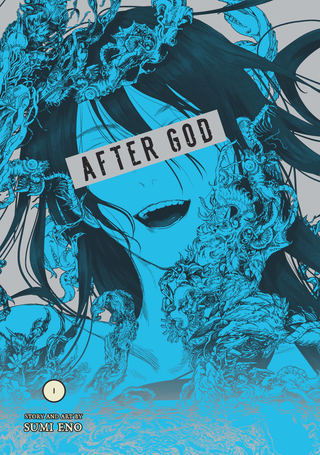
In the vast landscape of contemporary Seinen manga, few titles manage to blend cosmic horror, psychological depth, and breathtaking artistry as seamlessly as "After God" by Sumi Eno. Since its serialization began on the *Manga One* app, this series has captivated readers who crave a more mature, unsettling take on the "supernatural invasion" trope. If you are looking for a story that challenges your perception of divinity and humanity, "After God" is an essential addition to your reading list.
The Premise: A World Under the Shadow of Giants
The story of "After God" is set in a modern-day Japan that has been irrevocably altered. Thirty years prior to the start of the narrative, mysterious entities known as "Gods" descended upon the earth. However, these are not the benevolent deities of ancient myth. They are colossal, incomprehensible beings whose mere presence warps reality and brings destruction.
Japan has been carved into "Danger Zones"—abandoned urban sprawls like Shinjuku that are now the permanent residences of these stationary, silent titans. The government has established the Anti-God Research Institute, a specialized organization dedicated to studying these entities and, if possible, finding a way to eliminate them. The world lives in a state of "new normal," where the threat of divine annihilation is a constant, background hum to everyday life.
The Protagonist and the Catalyst
The narrative follows Waka, a young woman who enters a restricted Danger Zone with a singular, seemingly suicidal mission: to find her missing friend. Unlike the terrified civilians or the clinical researchers, Waka moves through the ruins with a haunting lack of fear. It is here that she encounters Tokinaga, a high-ranking researcher from the Anti-God Institute who is tasked with monitoring the "Gods."
The encounter triggers a series of events that reveal the dark core of the series. Waka is not an ordinary girl. She harbors a deep-seated hatred for the Gods and possesses a physiological connection to them that defies scientific explanation. As Tokinaga becomes entangled in Waka’s journey, the line between "human" and "God" begins to blur, leading to a high-stakes game of biological warfare and existential dread.
Demographics and Genre
"After God" is firmly rooted in the Seinen demographic. While it features intense action sequences that might appeal to Shonen fans, its complexity, graphic body horror, and philosophical inquiries target an older audience. It sits comfortably alongside titles like *Ajin: Demi-Human* or *Land of the Lustrous*, offering a sophisticated narrative that prioritizes atmosphere and character psychology over simple power scaling.
Core Themes: Divinity as Horror
The most striking theme of "After God" is its subversion of the divine. Sumi Eno explores Cosmic Horror, where the "Gods" are indifferent to human life. They do not demand worship; they simply exist, and their existence is toxic to our reality. This leads to the theme of Humanity vs. The Incomprehensible, as characters struggle to apply logic to beings that operate on a completely different plane of physics.
Furthermore, the manga delves into Grief and Obsession. Waka’s drive is fueled by loss, and the series frequently questions how far one should go to reclaim what was taken by an uncaring universe. The Ethical Cost of Survival is also a recurring motif, as the Anti-God Research Institute often resorts to morally gray experiments to bridge the gap between human frailty and divine power.
Why You Should Read It
Visually, "After God" is a masterpiece. Sumi Eno’s art style is characterized by sharp lines, intricate character designs, and a masterful use of negative space that emphasizes the scale of the Gods. The creature designs are particularly noteworthy—they are surreal, beautiful, and terrifying all at once.
For fans of psychological thrillers and dark fantasy, "After God" offers a refreshing departure from standard tropes. It is a story about the scars left behind by the "divine" and the terrifying evolution required to survive in their wake. As Waka and Tokinaga descend deeper into the mystery of the Danger Zones, readers are treated to a narrative that is as intellectually stimulating as it is visually haunting.
In conclusion, "After God" is more than just a survival manga; it is a profound exploration of what it means to live in the aftermath of a miracle that turned into a nightmare. It is a must-read for any "otaku erudito" looking for the next great Seinen epic.
📖 Leer online en Donmanga:
➡️ After God – Leer Manga