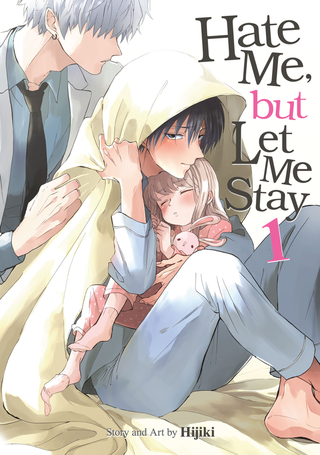
For any seasoned connoisseur of the Boys’ Love (BL) genre, the name Isaku Natsume carries a weight of prestige. Known for her clean art style, expressive character designs, and the perfect balance between lighthearted comedy and poignant emotional tension, Natsume has a knack for capturing the "slow burn" like few others. Today, we dive deep into one of her compelling works: "Hate Me, but Let Me Stay" (originally titled *Kirai da kedo, Soba ni Isasete*).
Demographic and Genre
"Hate Me, but Let Me Stay" falls squarely into the Yaoi / Boys’ Love demographic. Specifically, it is a contemporary Slice of Life Romance that utilizes the "childhood friends to lovers" trope—a staple of the genre—but infuses it with a unique psychological friction. Unlike more explicit or high-fantasy BL, this work focuses on the internal landscape of its protagonists, making it a must-read for those who appreciate character-driven narratives over pure plot-driven spectacle.
Detailed Plot Synopsis
The story centers on the complex relationship between two high school students: Naoto and Taichi. Having grown up as neighbors and inseparable companions, their bond is deep-rooted, yet fundamentally asymmetrical.
Naoto is a reserved, somewhat sensitive young man who has harbored a crushing, unrequited love for Taichi for years. On the other hand, Taichi is the quintessential "popular guy"—charismatic, athletic, and seemingly oblivious to the romantic turmoil he causes in his best friend. As they navigate the final years of high school, the pain of being "just a friend" becomes unbearable for Naoto. Every time Taichi talks about girls or treats Naoto with a casual, platonic intimacy, it feels like a needle to Naoto’s heart.
Driven to a breaking point, Naoto decides that the only way to protect his sanity is to sever the tie. He begins to act cold, avoiding Taichi and attempting to build a life where his world doesn't revolve around his childhood friend. He wants to "hate" Taichi—or at least, he wants to hate the feeling of loving him.
However, Taichi’s reaction is the catalyst for the manga’s central conflict. Instead of letting Naoto drift away, Taichi becomes intensely possessive. He cannot understand why his "safe haven" is suddenly pushing him out. This creates a fascinating "push and pull" dynamic: Naoto tries to create distance to heal, while Taichi, driven by a mix of confusion and a latent, unrecognized affection, clings even tighter. The title, *Hate Me, but Let Me Stay*, perfectly encapsulates this paradox—the desperate plea to remain in someone’s orbit even when the relationship has become a source of mutual friction.
Main Themes
1. The Burden of Proximity: The manga explores how being "too close" to someone can be a curse. When you know someone’s every habit, the line between platonic comfort and romantic longing becomes dangerously blurred.
2. Emotional Masochism vs. Self-Preservation: Naoto’s struggle is a classic depiction of the "martyr" in love. He stays close because he can't imagine life without Taichi, even though staying close is exactly what prevents him from moving on.
3. The Fear of Change: For Taichi, the primary theme is the terror of losing the status quo. His possessiveness isn't initially born of romance, but of a deep-seated fear that his identity is too intertwined with Naoto’s to let him go.
4. Communication Breakdown: As with many of Isaku Natsume’s works, the drama stems from what is *unsaid*. The tension builds through misinterpreted gestures and the heavy silence that follows a moment of unintended vulnerability.
Why You Should Read It
Isaku Natsume’s artwork is, as always, a highlight. Her ability to draw subtle facial expressions—a furrowed brow, a lingering look, or a forced smile—adds layers of depth to the dialogue. **"Hate Me,
📖 Leer online en Donmanga:
➡️ Hate Me, but Let Me Stay – Leer Manga