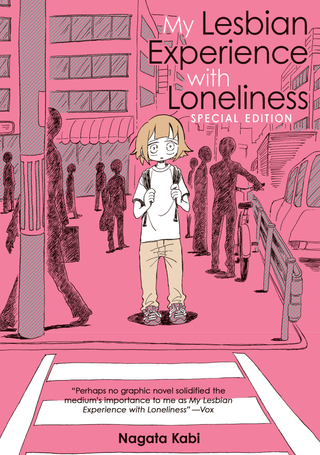
Kabi Nagata’s "My Lesbian Experience With Loneliness" (*Sabishisugite Lesbian Fuuzoku ni Ikimashita Report*) is not merely a manga; it is a visceral, raw, and profoundly courageous excavation of the human psyche. Originally a viral sensation on the Japanese art site Pixiv, this autobiographical "essay manga" was later published by East Press and brought to the West by Seven Seas Entertainment. The Special Edition elevates this seminal work, offering a high-quality hardcover format that honors the weight of its subject matter. As an erudite observer of the medium, I can assert that few works in the last decade have dismantled the stigma surrounding mental health and sexuality with such disarming honesty.
Demographic and Context
Categorized primarily as Seinen, the manga targets an adult audience capable of navigating complex emotional landscapes. While the art style—rendered in a minimalist, two-tone palette of black and vibrant pink—might initially suggest a whimsical tone, the content is deeply mature. It belongs to the "essay manga" (*zuihitsu*) subgenre, where the mangaka (author) serves as both the protagonist and the narrator, bridging the gap between personal diary and social commentary.
Plot Overview: The Struggle for Existence
The narrative follows a fictionalized version of Kabi Nagata during a "lost decade" of her life. After graduating from high school, Nagata finds herself paralyzed by the expectations of adulthood. She is unable to maintain a steady job, dropping out of art school and cycling through various part-time positions (*arubaito*) that leave her physically and mentally depleted.
The story documents her descent into a spiral of depression, anxiety, and an eating disorder (bulimia), which she depicts not as a choice, but as a desperate coping mechanism for a body that feels like a prison. For ten years, Nagata lives as a "NEET" (Not in Education, Employment, or Training), feeling increasingly alienated from a society that demands productivity and conformity.
The "inciting incident" of the memoir occurs when Nagata, nearing her 30s and having never experienced physical intimacy or a romantic relationship, makes a radical decision. Realizing that her lack of self-worth is tied to her total disconnection from her own body and sexuality, she decides to hire a female escort. This isn't a story of salaciousness, but one of "rehabilitation." She seeks a professional encounter to break the walls of her loneliness and to finally understand her own identity as a lesbian in a culture that often renders such identities invisible.
Core Themes: The Architecture of Loneliness
1. Mental Health and the "Social Mask":
Nagata masterfully illustrates the concept of *honne* (true feelings) versus *tatemae* (public face). She explores how the pressure to "be normal" leads to self-harm and the fragmentation of the self. Her depiction of depression is one of the most accurate in the medium, showing it not just as sadness, but as a profound, heavy inertia.
2. Physicality and Touch:
A central theme is the "hunger" for human contact. Nagata explores how the absence of touch can lead to a dissociation from one's own skin. The act of hiring an escort is framed as a desperate attempt to "re-enter" her own body and validate her existence through the gaze and touch of another.
3. The Search for Autonomy:
The manga is a journey toward agency. By documenting her failures and her small, agonizing steps toward self-improvement, Nagata challenges the reader to find beauty in the struggle. It is a story about the "labor" of living and the courage required to simply say, "I am here, and I am hurting."
Why the Special Edition Matters
The Special Edition is essential for collectors and scholars of the medium. It compiles the original groundbreaking work with the production values it deserves. The pink-and-black color scheme is more than an aesthetic choice; it represents the duality of Nagata’s life—the darkness of her depression contrasted with the "pink" flush of vulnerability and burgeoning desire.
In conclusion, *My Lesbian Experience With Loneliness* is a masterpiece of the Seinen demographic. It transcends the boundaries of LGBTQ+ literature to become a universal anthem for anyone who has ever felt "broken" or left behind by the relentless pace of the world. It is a haunting, yet ultimately hopeful, reminder that the first step toward healing is the brutal honesty of self-recognition.
📖 Leer online en Donmanga:
➡️ My Lesbian Experience With Loneliness – Special Edition – Leer Manga