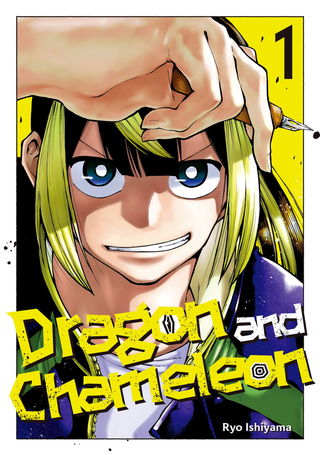
Dragon and Chameleon: A High-Stakes Psychological Battle of Artistic Souls
In the vast landscape of modern manga, few series manage to capture the grueling, soul-crushing, yet exhilarating reality of the creative industry quite like *Dragon and Chameleon* (*Dragon to Chameleon*). Written and illustrated by the talented Ryo Ishiyama, this series is a masterclass in psychological tension, blending the supernatural "body swap" trope with a cutthroat exploration of the manga world. If you are looking for a story that treats the act of drawing as a literal battlefield, this is a title you cannot afford to miss.
The Premise: A Clash of Two Extremes
The story centers on two men at opposite ends of the manga hierarchy. On one side, we have Hanagami Shinobu, the "Dragon." Hanagami is a generational genius, a superstar mangaka whose work is defined by its raw power, overwhelming charisma, and an "indomitable soul" that leaps off the page. He is the king of the industry, but his success has left him somewhat isolated by his own perfectionism.
On the other side is Miyama Shinobu, the "Chameleon." Miyama is a highly skilled assistant who possesses a terrifying ability: he can perfectly mimic the art style of any creator he works for. However, Miyama lacks a "soul" of his own. He is a hollow vessel, a man who has mastered the craft of imitation but possesses no original vision. He harbors a deep-seated resentment toward the "geniuses" of the world, believing that his technical mimicry makes him superior to those who rely on fickle inspiration.
The plot takes a supernatural turn when a freak accident causes the two to swap bodies. The "Dragon" is now trapped in the body of an obscure, talentless assistant, while the "Chameleon" inhabits the body of the world’s most famous mangaka.
The Struggle for Authenticity
What follows is not a lighthearted comedy, but a fierce Seinen drama. Miyama (in Hanagami’s body) intends to use his mimicry to steal Hanagami’s life, believing he can maintain the "Dragon's" throne by simply faking the art. He views manga as a product to be manufactured.
Conversely, Hanagami (in Miyama’s body) is faced with an impossible challenge. Stripped of his fame, his resources, and his established brand, he must climb back to the top of the industry starting from zero. The core conflict explores a fascinating question: Is genius tied to the physical hand and the reputation, or is it something inherent in the spirit? Hanagami’s journey is one of proving that even in a "weak" body, his creative fire is inextinguishable.
Demographic and Tone
*Dragon and Chameleon* is categorized as Seinen, serialized in *Monthly Comic Zenon*. Unlike Shonen battle manga where characters fight with swords or energy blasts, the "combat" here is fought with G-pens, ink, and manuscript paper. The tone is intense, sophisticated, and often dark, focusing on the psychological toll of the weekly serialization grind. It appeals to an older audience that appreciates the nuances of professional rivalry, the philosophy of art, and the "behind-the-scenes" politics of publishing houses and popularity polls.
Key Themes: Talent vs. Technique
The manga dives deep into several profound themes:
1. The Nature of Originality: Can a perfect copy ever surpass an imperfect original? The series constantly pits Miyama’s technical perfection against Hanagami’s raw, emotional "errors" that give his work life.
2. The Industry’s Cruelty: It provides a cynical yet realistic look at the manga industry—the pressure of rankings, the fickle nature of fans, and the way editors manipulate talent for profit.
3. Identity and Ego: Both characters must confront who they are when their outward shells are stripped away. For Hanagami, it’s a test of his ego; for Miyama, it’s a desperate attempt to fill his inner void.
Why You Should Read It
*Dragon and Chameleon* stands out because of Ryo Ishiyama’s incredible art. The "meta" nature of the story requires the artist to draw in multiple styles to represent the different "fictional" manga within the plot, and Ishiyama executes this flawlessly. The visual metaphors—depicting creative blocks as physical monsters or artistic breakthroughs as explosive forces—make the act of drawing feel as high-stakes as any Shonen tournament.
For fans of *Bakuman*, *Blue Period*, or *Oshi no Ko*, *Dragon and Chameleon* offers a darker, more aggressive take on the creative process. It is a thrilling psychological thriller that asks: If someone stole your life, could you win it back using nothing but your talent?
📖 Leer online en Donmanga:
➡️ Dragon and Chameleon – Leer Manga